
Guardsman Air Duct Cleaning in Suffolk: A Homeowner’s Guide
Home warranty duct cleaning referrals usually arrive with a brand name attached and a subcontractor doing the actual work. The gap between those two things is where service quality lives. In Suffolk, a homeowner calling about a Guardsman referral often assumes the brand means a standard of work. It doesn’t. Guardsman is a name on the paperwork; the subcontractor who shows up determines what gets cleaned, how, and whether the job holds up if you ever need to dispute it. This guide walks through what to check before anyone touches your system.
How are warranty-referred duct cleaning jobs structured in Suffolk?
A warranty-referred duct cleaning in Suffolk is usually a fixed-scope job: the warranty pays for a defined cleaning package, and any work outside that scope becomes the homeowner’s cost. The paperwork matters more than the brand name on the referral. Before you schedule, read what the warranty document actually lists as covered, and write down what it doesn’t mention, because that gap is where out-of-pocket costs get introduced.
Commonly, a warranty covers:
- Basic cleaning of main supply and return trunk lines
- Access to registers and grilles in accessible areas
- Removal of loose surface debris from duct interiors
Usually out-of-pocket, depending on the policy:
- Cleaning of branch runs beyond the main trunks
- Sanitizing or antimicrobial fogging
- Duct repair or resealing compromised sections
- Dryer vent cleaning, which sits outside most HVAC duct warranties
Get the scope in writing from the assigned subcontractor before the visit. If they can’t tell you what they’ll clean and what sits outside the covered portion, that’s a signal to slow down. The schedule of coverage your policy defines is the baseline; the subcontractor’s interpretation of that schedule is what actually gets delivered.
What equipment should you ask about before a referred subcontractor starts?
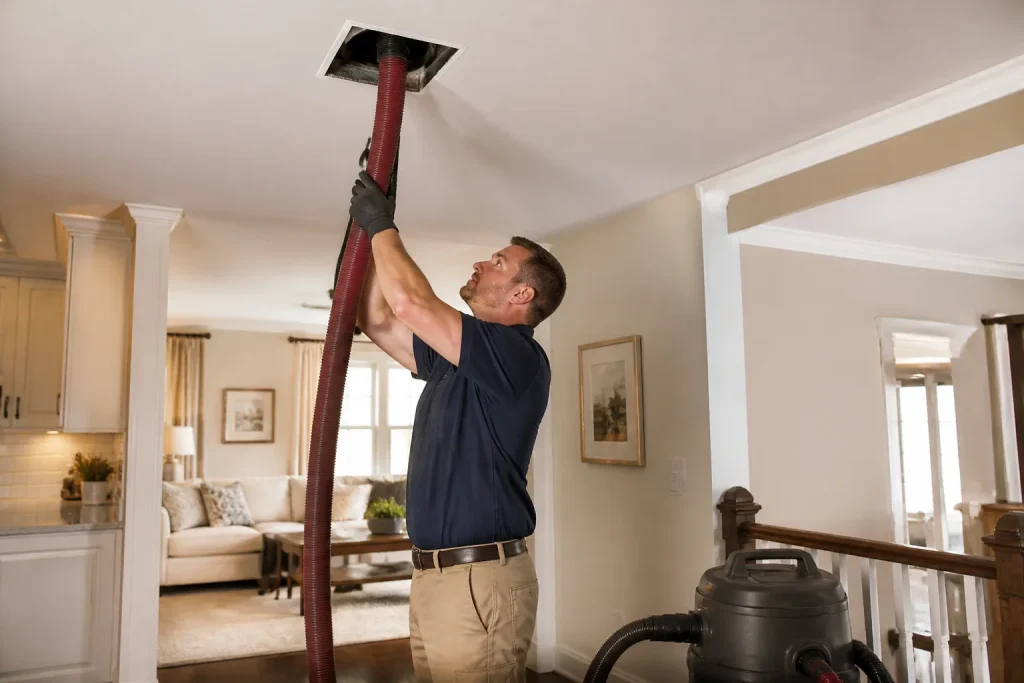
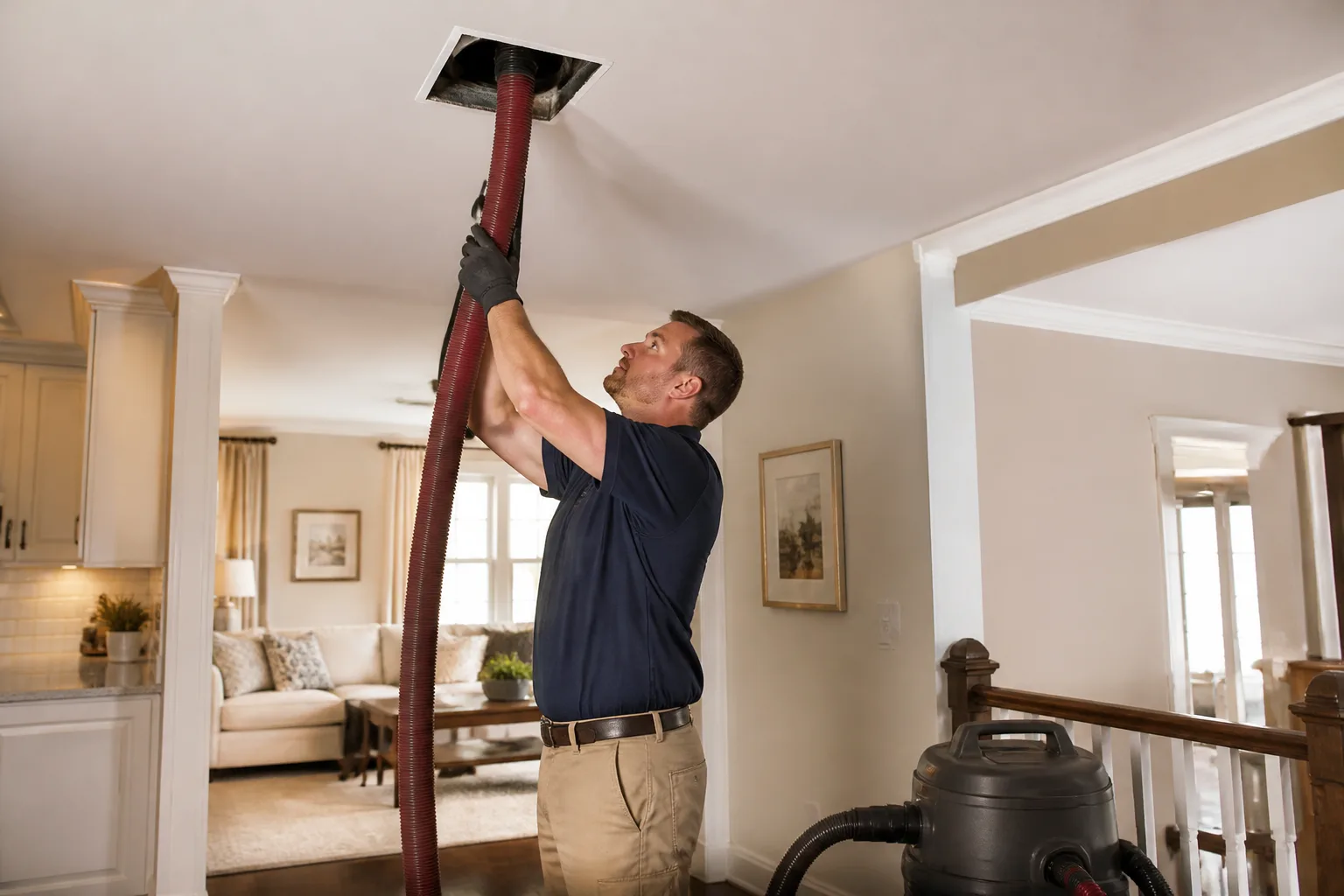
Ask directly: does the crew use a truck-mounted or high-powered portable vacuum with a contact-cleaning tool, or a shop-vac style unit? Suction volume is the whole game. A consumer-grade vacuum cannot move the volume of air needed to pull debris out of a duct system; it agitates dust and pushes it further in. Professional systems use negative pressure to hold debris in the ducting while a rotating brush loosens it, then extract it in one pass.
The equipment names to listen for are Rotobrush and Nikro. Rotobrush contact-cleaning tools scrub duct interior walls as they extract; Nikro units provide the high-volume vacuum lifting debris out of the run. Abatement Technologies negative-air equipment is a further sign of containment-level rigor: it keeps the work area under pressure so dust doesn’t migrate into living space during the job.
Why this matters in Suffolk specifically: homes here sit in a humid summer pattern where ductwork interior stays damp for stretches. That moisture helps debris cake and adhere, and a low-suction unit simply can’t break it loose. If the sub can’t name their equipment or describes a “blow-and-go” setup, ask whether they’d walk you through the suction rating before starting. A professional won’t hesitate.
What should a NADCA-standard cleaning include?
NADCA-standard cleaning, as most professionals describe it, covers source removal, not just a surface pass. The standard itself is a useful checklist: if a referred job hits every point, the scope is real. If a sub skips several, they’re doing partial work and calling it a cleaning.
A compliant cleaning typically includes:
- Full-system negative pressure established before any brushing starts
- Contact cleaning of the supply and return trunks plus branch runs
- Cleaning of registers, grilles, and diffusers
- Cleaning of the air handler interior, blower, and evaporator coil area where accessible
- Photos before and after at each major component
- Restoration of all access holes created for cleaning
That last point matters. Any technician who cuts access into ductwork must seal it back correctly; uncovered holes pull attic or crawlspace air into your system. Here in Suffolk, where many homes have duct runs in unconditioned attic space, an unsealed access hole is a real efficiency problem, not a cosmetic one. If your home has air duct cleaning scheduled under a referral, ask the sub whether they’ll document each access point and photograph the reseal.
Which upsells are warranted and which aren’t?
Sanitizers and duct coatings are the two offers you’ll most often see added to a warranty-referred cleaning. The question isn’t whether they exist; it’s whether your situation calls for either one. Most homes don’t need them on a standard cleaning.
A sanitizer is worth discussing when there’s a specific reason: persistent mustiness, a known mold or microbial issue flagged by another inspection, or a recent water intrusion affecting the HVAC system. Fogging a healthy duct system just to fog it is a cost, not an improvement.
Duct coatings are much more niche. They’re used to seal a porous or damaged duct interior that’s already been identified as failing. On a system that’s structurally sound, a coating is unnecessary. If a technician recommends either treatment before they’ve opened the system and looked, ask what they found and where. A written finding, with a photo, is the standard. A verbal suggestion on arrival is not.
Two things to remember when the add-on conversation starts: the estimate should be written and agreed before any additional work begins, and you can always say “clean what’s covered today, I’ll consider the rest.” No professional argues with that.
Can you fix duct problems the cleaner finds?
A cleaning can reveal problems it can’t solve: disconnected runs, crushed flex duct, torn interior liner, gaps at boots and plenums. A referral cleaning is often a one-service job, which means the found defect gets noted and left. The homeowner is then holding two problems: contamination and compromised ductwork. Our Suffolk page walks through how the local housing stock tends to produce these findings, and it’s a familiar pattern in older homes with flex runs installed in tight attic space.
Air duct repair closes that gap. Reconnecting, resealing, and replacing damaged sections keeps the cleaning you paid for intact, and it protects efficiency that leaky ductwork throws away. The whole-home filtration angle matters here too: if the home has a Honeywell or Aprilaire system in place, a technician who understands how that equipment integrates with the duct system can spot restrictions and airflow problems a general cleaner might miss. Familiarity with those systems isn’t a luxury; it means fewer surprises after a repair.
How do you document a warranty-referred cleaning?
Take photos before, during, and after. Request the same from the subcontractor, and keep them on file with the warranty paperwork. If a future claim comes up, the documentation is your leverage. Verbal assurances and a receipt that says “duct cleaning completed” won’t help you argue the work wasn’t done properly.
What to keep:
- Before-and-after photos of every major component, especially the air handler and main trunks
- The subcontractor’s written scope, signed or emailed on the day of service
- The warranty authorization number and the schedule of covered work
- Any recommended follow-up in writing
The one time-honest rule every homeowner should know: duct cleaning isn’t a routine annual line item. Industry guidance generally puts it on a multi-year cycle for most homes, more often after renovation or with pets. A referral that shows up every year to “reclean” is a sales calendar, not a maintenance need. If a dryer vent is on the same warranty list, treat it separately; dryer vent cleaning addresses NFPA-cited fire risk, and it’s worth doing on its own schedule regardless of what a warranty covers.
When to call a pro (and when the referral route doesn’t fit)
If you’re in Suffolk and the warranty process feels like more work than the cleaning, or the subcontractor assigned can’t answer the equipment and scope questions above, it’s fine to schedule directly. Our technicians have up to 12 years of experience, and we use Rotobrush and Nikro systems with Abatement Technologies negative-air containment on every job. One flat price per system, agreed in writing before work starts.
Related services in Suffolk: Duct Cleaning Suffolk covers the three-service scope (air duct cleaning, dryer vent cleaning, and air duct repair) with the same equipment standard across all of them.
The Bottom Line
The Guardsman name on the paperwork doesn’t determine the quality of the work. The subcontractor, the equipment they bring, the written scope, and the documentation do. Ask the equipment question, read the coverage details, treat upsells as questions rather than defaults, and keep a photo record. If you’re in Suffolk and need help, Duct Cleaning Suffolk offers free estimates: call (855) 740-0661. We answer 24/7. Fast dispatch from 7am to 7pm, Sunday through Friday.
Frequently Asked Questions
Usually not for the covered scope, but homeowner cost often appears when the covered work is narrow and the extra work (branch runs, sanitizing, repairs) sits outside the policy. Get the scope in writing before the visit. If the out-of-pocket portion matters, call (855) 740-0661 for an independent estimate to compare against.
Before-and-after photos at every major component, plus a written scope, are how you verify. If a cleaner can’t provide photos, the work isn’t documented; that’s the answer. Ask for the same record from any referral job and keep it with the warranty file. For an independent quote with documented results, call (855) 740-0661.
Not on most jobs. It’s a reasonable add-on when there’s a specific finding (mustiness, a known microbial or water issue), not on a routine cleaning of a healthy system. Ask what the technician found, where, and for a photo. If they can’t answer, skip the add-on and call (855) 740-0661 to talk it through.
Multi-year cycles for most homes, more frequently after renovation or with heavy pet dander. It isn’t annual maintenance for most households. Here in Suffolk, the humid summer swings and homes with attic-run flex ducts tend to be the two factors that push a cleaning up the schedule. Not sure where your system falls? Call (855) 740-0661. We answer 24/7. Fast dispatch from 7am to 7pm, Sunday through Friday.
Written by the team at Duct Cleaning Suffolk.
Need Air Duct Cleaning Help?
Call Duct Cleaning Suffolk - licensed & insured, here with fast help in Suffolk.
(855) 740-0661