
How to Choose the Right Air Duct Cleaning Company in Suffolk
Most homeowners pick a duct cleaner by scanning reviews and comparing prices, then book whoever answers first. That works about as well as choosing a surgeon by Yelp stars. Joining NADCA costs a company roughly $400 a year. It’s a minimum threshold, not a quality guarantee, and it tells you almost nothing about the equipment that will show up in your driveway. In our experience, the company behind the van and the process they follow matter far more than the logo on the invoice. If you’d rather skip the detective work and get a straight answer, call (855) 740-0661.
What Should You Ask Before Booking a Duck Cleaner in Suffolk?
The single best question is about equipment, because it separates professionals from blow-and-go operators before anyone gets near your vents. Ask the person who answers the phone exactly what vacuum system they use and what its airflow rating is. A truck-mount or certified high-power unit measured in CFM is the standard; a credible answer names the machine and the number without hedging. A deflection (“we use the best on the market”) is your signal to keep dialing.
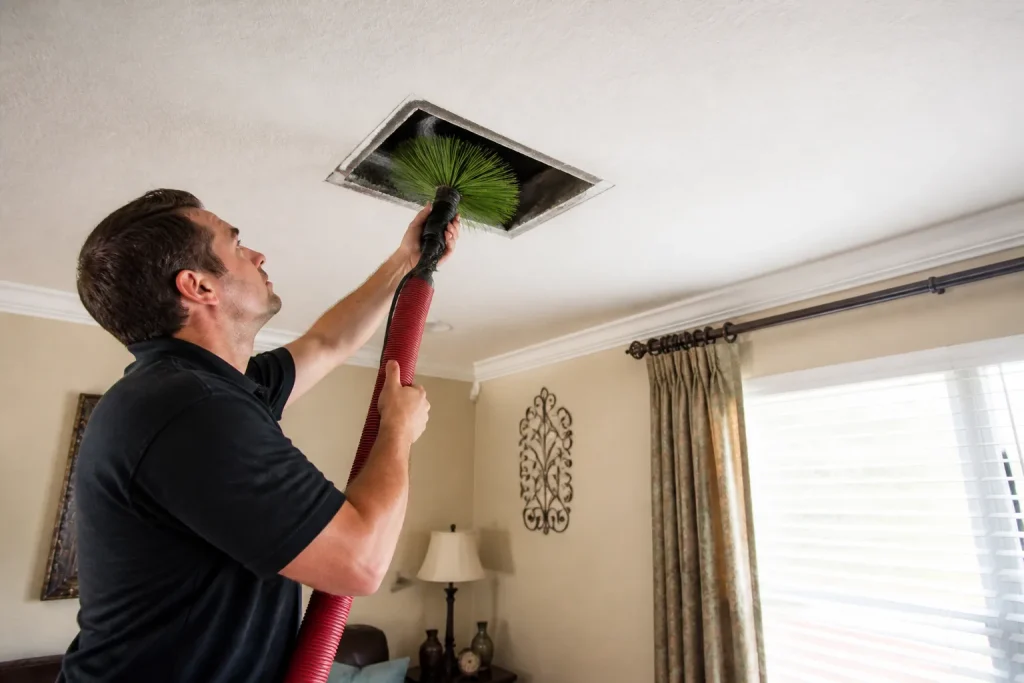
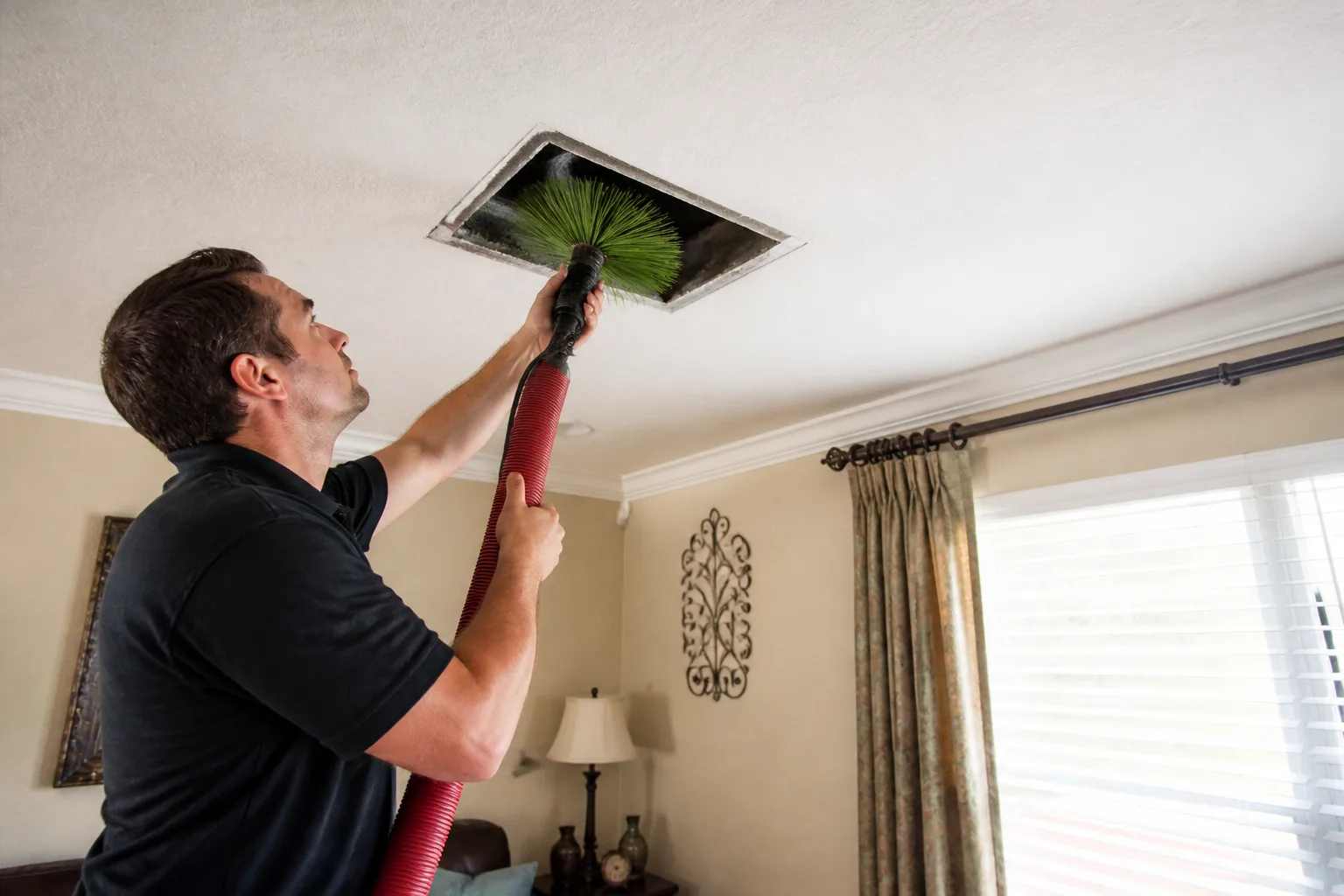
In Suffolk, where many homes have older galvanized ductwork and a mix of add-on HVAC upgrades, weak suction can actually make things worse. A shop-vac and a blower push loose debris into the living space or deeper into the system rather than removing it. Professional-grade equipment couples real suction with contact agitation, which is why we run Rotobrush contact-cleaning systems and Nikro high-powered vacuum units on Suffolk jobs. Those are the same tools certified HVAC and remediation crews rely on.
Three questions to have ready:
- What vacuum system do you use, and what’s the airflow rating? Listen for a model name and a CFM figure.
- Do you use negative-air containment? A yes means debris gets captured, not redistributed through the house.
- What agitates the duct walls? Contact cleaning takes more than suction alone.
The answers tell you more about the service than any star rating. For a deeper look at the full scope of air duct cleaning, that’s where we lay out the process end to end.
Why Does a Pre-Job Inspection Matter?
A camera or scope inspection before any work begins is a process signal, not an upsell, and it’s one of the clearest tells in this trade. A company that scopes first is showing you they intend to diagnose before they clean. A company that schedules you for same-day service with zero inspection is showing you the opposite: they don’t know what’s in your ductwork, and they aren’t planning to find out until they’re already charging you.
During a pre-job inspection, a technician should look at the air handler, the supply and return trunks, and any accessible runs. A scope or camera confirms what kind of buildup exists, whether there’s visible mold or biological growth, and whether ductwork has come apart or crushed at a joint. That last point is where capability separates a cleaning company from one that cleans and leaves. We offer air duct repair as a dedicated service precisely because we’ve seen too many systems that were cleaned but never fixed.
What the inspection tells you as the homeowner:
- Whether the quoted price reflects your actual system or a flat guess.
- Whether the company can identify compromised ductwork instead of just cleaning around it.
- Whether the crew knows your equipment, including Honeywell or Aprilaire filtration components.
If a company won’t inspect before quoting, the quote is a guess. In a market as varied as Suffolk, where homes range from older builds to newer construction, guesswork is exactly what you don’t want.
What Should a Cleaning Scope Checklist Include?
A legitimate cleaning scope covers four specific areas, and you should ask for it in writing before the work starts: supply runs, return plenums, the air handler coil area, and register covers. If any of those is missing from a verbal quote, it isn’t a scope, it’s an estimate of how long the crew plans to be there.
Ask the office to send the scope in writing, then compare it against the work on the day. A proper scope reads like a checklist, names each component, and matches what the crew actually touches. If the written scope lists supply runs but the crew never removes the register covers, or skips the return plenum entirely, you’ve learned everything you need to know about their standards.
Here’s what a credible scope covers:
- Supply runs – the ducts that carry conditioned air into each room.
- Return plenums – the large return paths, often the dirtiest part of a system.
- Air handler coil area – the immediate cabinet area around the coil, where debris collects.
- Register covers – removed, cleaned, and reinstalled, not just wiped off.
Getting this in writing is also your protection against the classic bait-and-switch: a low headline price that swells once the technician is on site. If the scope is documented, the price should be documented too. One flat price per system, agreed before work starts, is how it should work. We back our work with before-and-after photos of your own system, so you can see the condition of your ducts before and after – not someone else’s promotional images.
The scope you want applies whether you’re in a Suffolk bungalow or a newer build near one of the growing subdivisions, so insist on it everywhere.
What Are the Real Red Flags Beyond a Low Price?
Price is the loudest red flag, but it’s rarely the first one to show up. The ones that should stop you cold:
- Same-day scheduling with no inspection. Speed is not a quality signal in duct work; scheduling you before the technician has seen the system means they’re guessing.
- Sanitizer pushed on first contact. A kill-everything chemical spray offered before anyone has assessed the ducts usually means the company is upselling, not diagnosing. A legitimate scope determines whether sanitizer is even appropriate.
- No mention of negative pressure containment. Without containment, debris lands on your furniture and in the air you breathe. Ask how they prevent that, and expect a concrete answer.
- Vague on the cable to the dryer. dryer vent cleaning is a fire-risk service, not a convenience add-on, and a credible company treats it as its own dedicated scope.
We’ve watched companies offer a low headline figure, then pile on charges for every vent and every add-on until the final invoice looks nothing like the quote. The defense is simple: one flat price per system, presented in writing before work begins, no per-vent pricing.
How Do You Verify Licensing and Insurance in Virginia?
In Virginia, licensing and insurance records are public, and you should take ten minutes to check them. Ask the company for their contractor license number and certificate of insurance. Then verify the license through the Virginia Department of Professional and Occupational Regulation (DPOR) and call the insurer to confirm the general liability policy is current. A certificate on a piece of paper is easy to fake; a current policy on file with the insurer is not.
The second question is where the company is actually based. An out-of-area operator serving Suffolk creates an accountability gap. If something goes wrong with your system, who do you call? Who climbs back into the attic to look at the ductwork? A company that treats Suffolk as a route stop has less reason to make it right than one that works the area consistently. None of this is about loyalty for its own sake; it’s about whether the person who sold the job is reachable when the work needs to be corrected.
Ask for:
- Contractor license number, and check it on DPOR.
- Certificate of insurance covering general liability, and verify it with the insurer.
- The address on the insurance certificate. Compare it to what they told you about where they operate.
This matters in Suffolk as much as anywhere else in Virginia. A few phone calls keeps you from being the homeowner who has to chase an out-of-area operator who has already moved on. For local questions and service details in the city itself, our Suffolk page is the place to look.
When Should You Call a Professional?
Call a professional when the problem points at the system itself, not just surface dust. You’ll have any of these signs:
- A dryer that takes far longer to dry a load than it should, which points to a restricted dryer vent.
- Visible dust blowing from the registers right after the system cycles on.
- A recent renovation, where construction dust and debris have likely settled into the ductwork.
- Allergy or asthma symptoms that seem to track with time spent indoors.
- A whole-home filtration system, such as a Honeywell or Aprilaire setup, that needs a technician who understands the equipment before touching it.
Those are all reasons to have someone with real equipment take a look. If you’re in Suffolk and want a straight read on your system, Duct Cleaning Suffolk is a good place to start. We answer 24/7, and fast dispatch runs from 7am to 7pm, Sunday through Friday. Estimates are free, but scheduling is not a same-day emergency pitch – call (855) 740-0661 and we’ll walk through what your system actually needs.
Related services in Suffolk: if the problem is a slow dryer, dryer vent cleaning; if ducts have come loose or crushed, air duct repair; if it’s routine buildup, air duct cleaning.
The Bottom Line
Choosing the right air duct cleaning company in Suffolk comes down to three verifiable things, not reviews and price alone. Ask about the equipment and expect a named vacuum system and a real airflow answer. Ask about the inspection and expect a camera or scope before any work. Ask for the scope in writing and expect supply runs, return plenums, the air handler coil area, and register covers, all with one flat price per system. Do the license and insurance check, and confirm the company is genuinely accountable if something needs to be fixed. None of that requires a technician’s training; it just requires asking the questions before anyone picks up a tool.
We use professional-grade equipment – Rotobrush, Nikro, and Abatement Technologies containment – because the tools are the process. Our technicians have up to 12 years of experience, and we work with the systems already in your home, including Honeywell and Aprilaire filtration setups. If you’re in Suffolk and need help, Duct Cleaning Suffolk offers free estimates. Call (855) 740-0661. We answer 24/7, with fast dispatch from 7am to 7pm, Sunday through Friday.
Frequently Asked Questions
It depends on the size of your system and its condition, which is why a written scope and a flat per-system price matter more than a headline number. A duct cleaner who quotes without inspecting is guessing. Ask for the scope first, then the price. Call (855) 740-0661 for a free estimate.
Cheap quotes usually skip the inspection, the containment, and part of the scope, and some make up the difference with add-on charges once the crew is in your home. A written scope with one flat price per system is how you avoid that. Ours is free and comes with before-and-after photos of your own system.
Ask for before-and-after photos of your own ducts, not stock images, and confirm the written scope was followed component by component. If a company can’t show you the condition of your system before and after, you shouldn’t book them. Call (855) 740-0661 to set up an estimate.
It depends on the home: a recent renovation, an older HVAC system, or a history of allergy or asthma symptoms all push the schedule tighter than a typical household. There’s no universal interval, so the honest answer is that it’s worth an inspection when those conditions apply. Call (855) 740-0661 for a free estimate.
Written by the team at Duct Cleaning Suffolk.
Need Air Duct Cleaning Help?
Call Duct Cleaning Suffolk - licensed & insured, here with fast help in Suffolk.
(855) 740-0661