
Last updated November 15, 2026
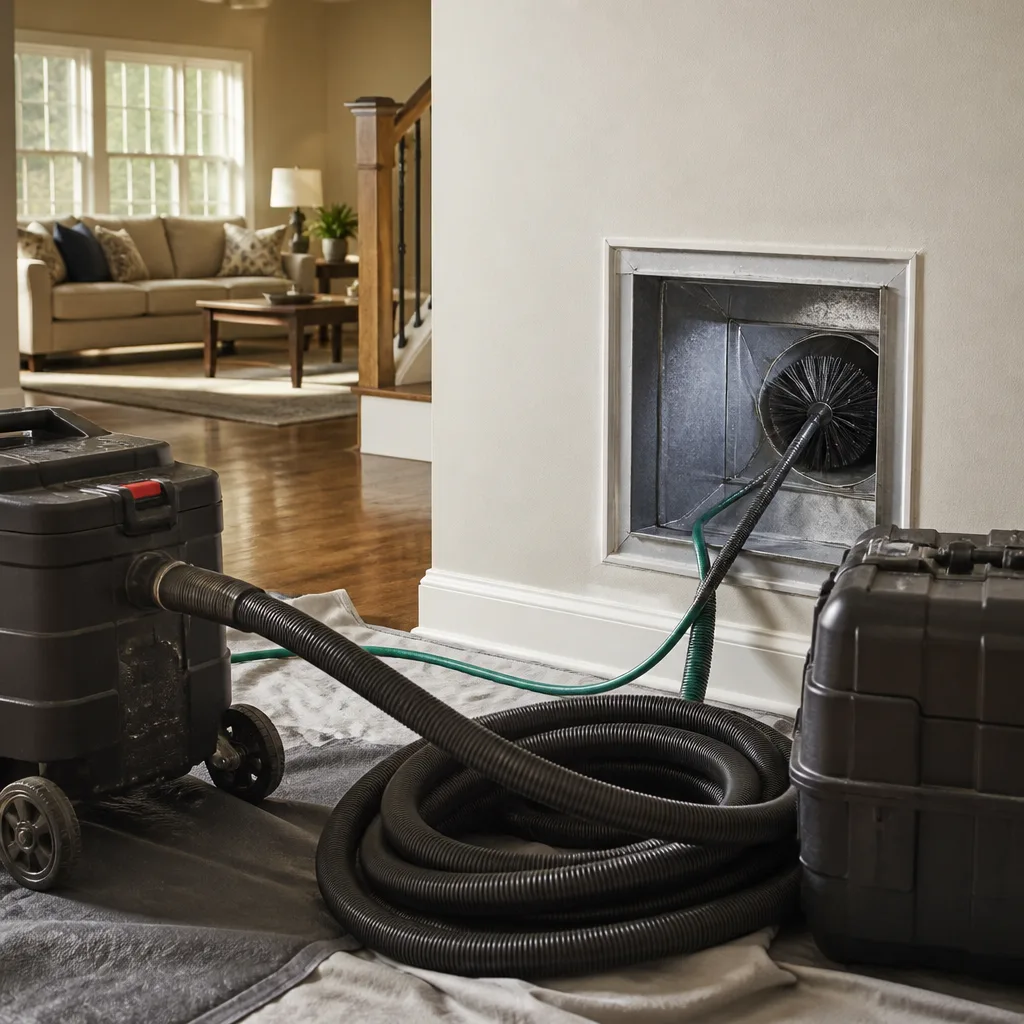 Whole-home duct cleaning
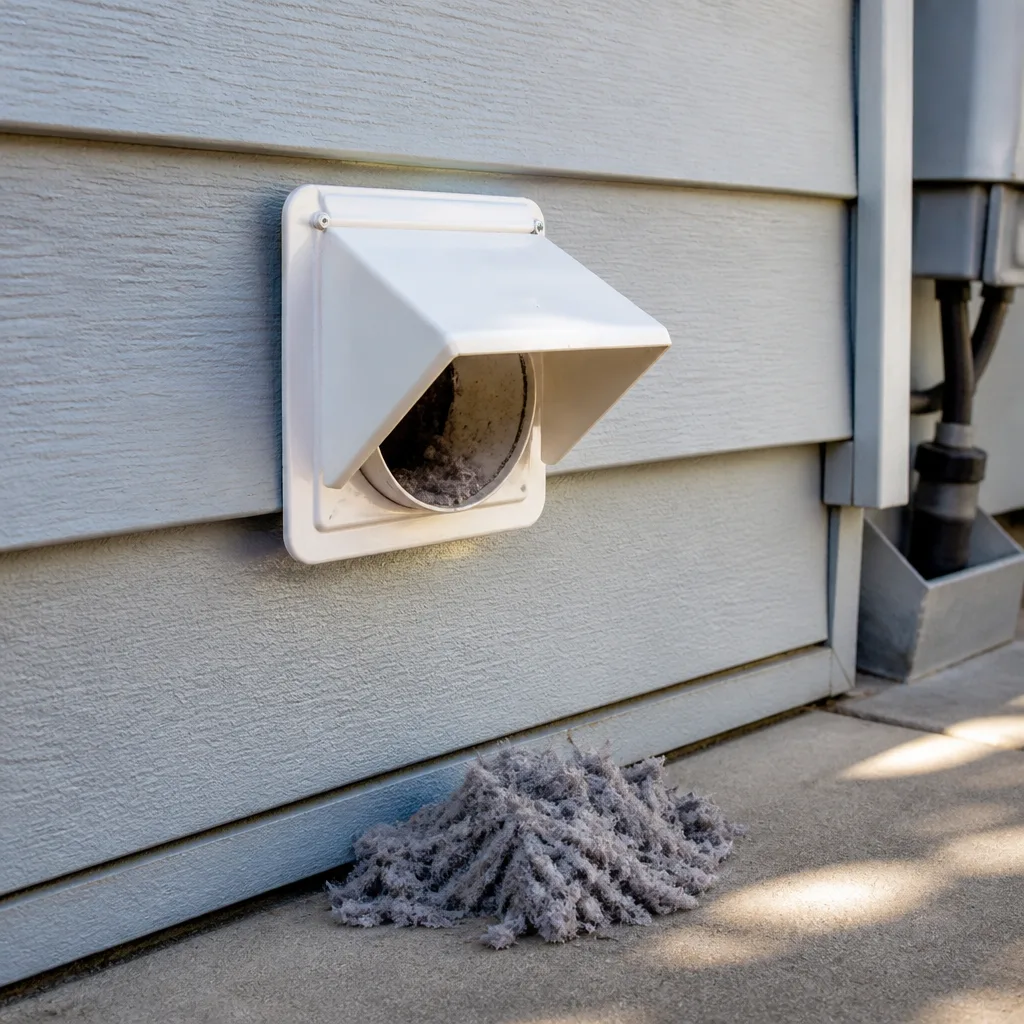 Dryer vent cleaning
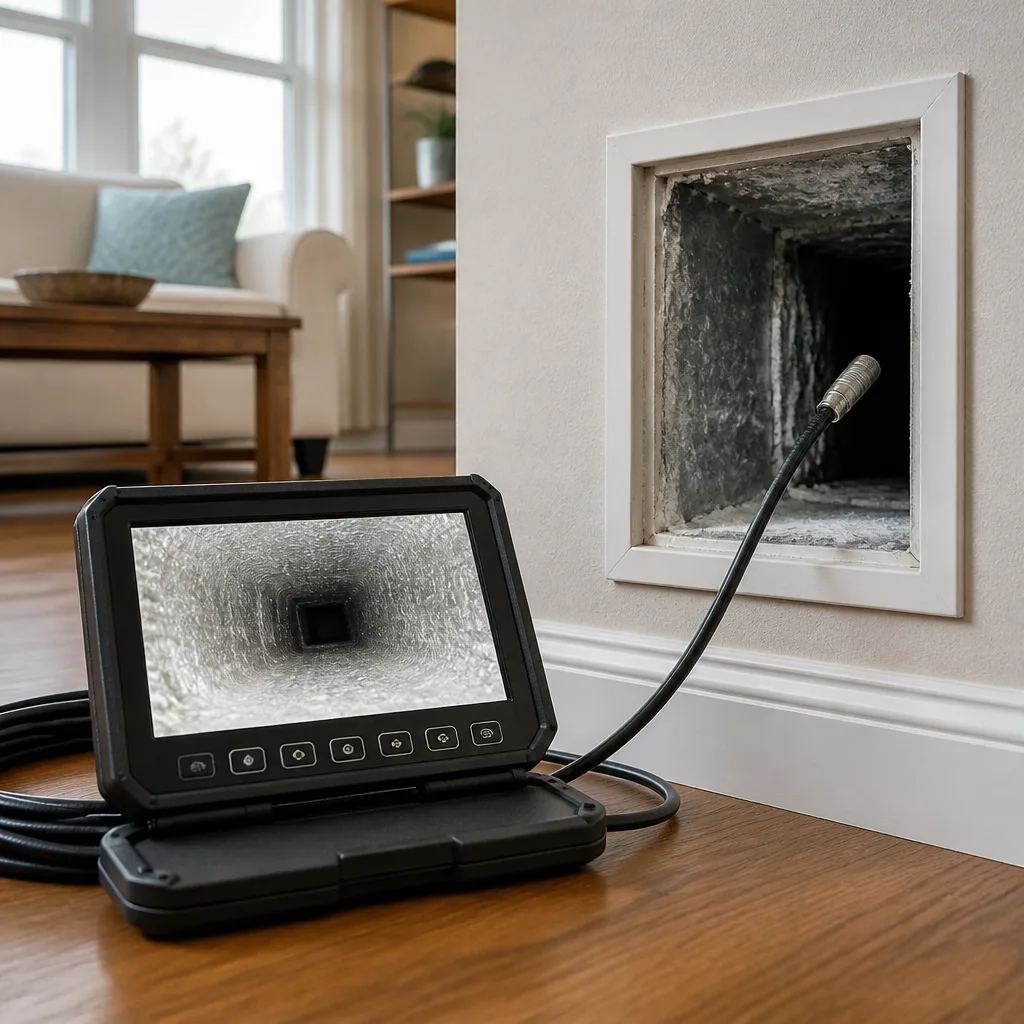 Camera inspection
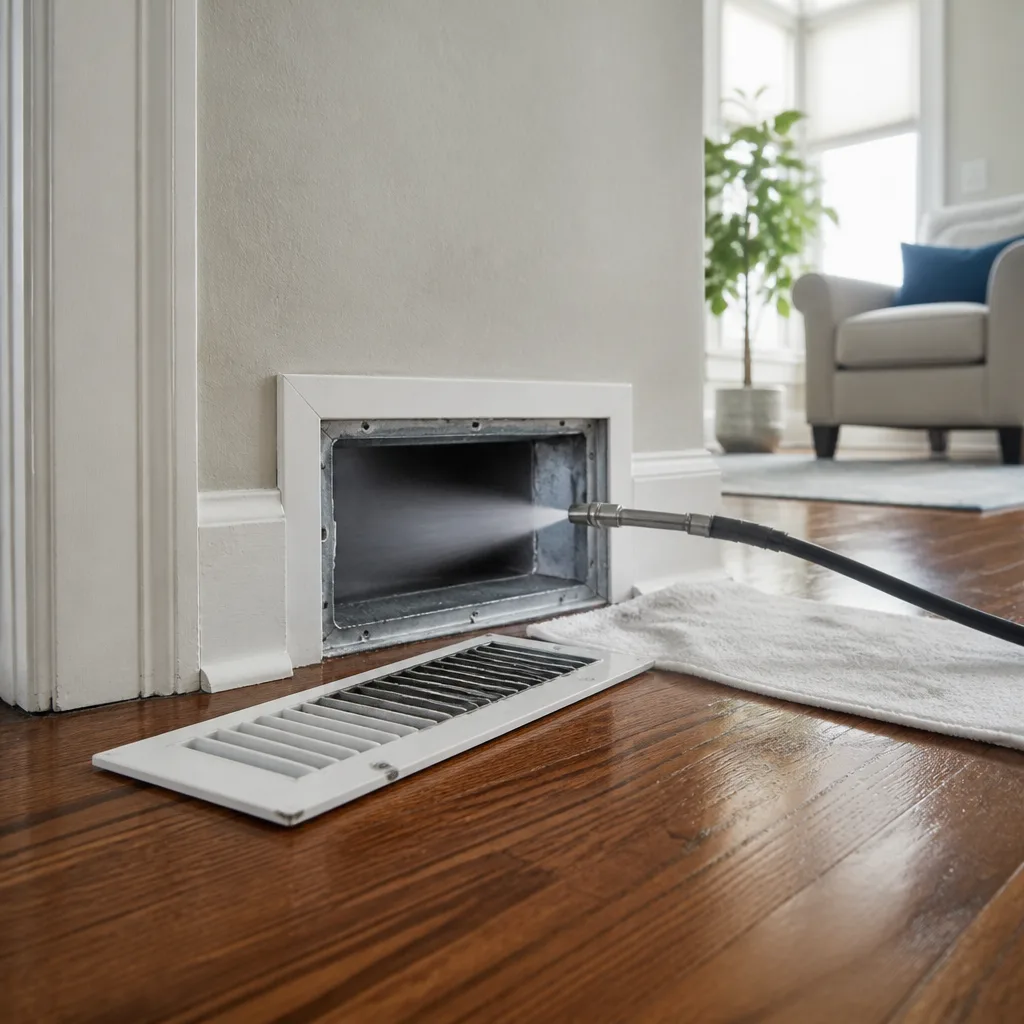 Sanitizing & deodorizing
Whole-system duct and dryer vent check with before-and-after photos - you see exactly what came out of your vents
That "$99 whole-house special" is a bait ad - the real number appears once they are in your hallway, or the "clean" is a shop-vac at the register. We photograph the inside of your ducts before and after instead.
DIY vs Professional Air Duct Cleaning: The Suffolk Homeowner’s Decision Guide
A consumer dryer vent cleaning kit from a hardware store works reasonably well for the first 10 feet of a dryer duct run. That’s exactly why it’s misleading. The kit clears the easy stretch, the dryer starts drying faster, and the homeowner concludes the whole run behind the wall is clean. It usually isn’t. DIY duct work isn’t dangerous or foolish – it’s structurally limited, and the limit falls much earlier than most people assume. This guide defines precisely what a shop-vac and brush kit can accomplish in a Suffolk home, where that approach stops working, and how to decide whether an afternoon project will actually solve your problem.
Quick Answer
DIY air duct cleaning can handle register grilles, the first few feet of accessible duct runs, and a partial dryer vent clearing. It cannot generate the negative pressure, agitation, or containment needed to clean a full duct system, and it can’t safely touch the air handler or coil compartment. For a Suffolk home with a full system that hasn’t been cleaned in years, or with older flex duct, professional cleaning is the only approach that actually removes debris rather than relocating it.
Styles & brands we work with
- Whole-home duct cleaning
- Dryer vent cleaning
- Camera inspection
- Sanitizing & deodorizing
Table of Contents
- What DIY Duct Cleaning Can Legitimately Accomplish
- What Only Professional Equipment Can Do
- The Specific Risk in Suffolk’s Older Housing Stock
- The Cost-Benefit Math: Maintenance vs. Skipping It
- Tools Worth Owning vs. Tools That Only Make Sense at Professional Scale
- Dryer Vents: Where DIY Helps and Where It Stops
- Working With Honeywell and Aprilaire Systems
- A Step-by-Step Way to Decide
What DIY Duct Cleaning Can Legitimately Accomplish
A homeowner with a shop-vac and a brush kit can do real, measurable work. The key is understanding that this work sits at the outer edges of the system, not inside it. Here’s what’s genuinely achievable.
- Register grille cleaning. Removing the floor and wall registers and washing them is legitimate maintenance. Dust, pet hair, and renovation grit collect on the grille face and the immediate opening behind it. Cleaning them improves airflow at the terminal and takes five minutes per register.
- The first 2 to 3 feet of accessible boot runs. If you can reach a duct run through an open register or a disconnected joint, a brush and vacuum can clear the first few feet. This is real work, and it does help.
- Partial dryer vent clearing. A consumer kit run from the dryer side or the exterior hood can clear the straight, accessible portion of a short dryer run. On a short run with a straight path, this genuinely reduces lint buildup.
- Return grille and filter housing cleaning. Vacuuming the return grille and the filter slot removes surface debris that would otherwise get pulled into the system.
- Exterior dryer hood cleaning. Wiping out the hood flapper and screen area is easy, cheap, and prevents a common airflow restriction.
None of this is wasted effort. In fact, this kind of maintenance between professional cleanings is worth doing. The trouble starts when homeowners mistake this surface work for full-system cleaning – and in Suffolk, where many homes have long duct runs from central air handlers to distant rooms, that gap between “the register looks clean” and “the system is clean” is wide.
What Only Professional Equipment Can Do
Full duct cleaning is a pressure and containment problem, not a brushing problem. Three things separate professional work from DIY that no shop-vac can replicate.
- Negative pressure extraction across the whole system. Professional units like Nikro high-powered vacuums pull the entire duct system into negative pressure, so loosened debris is captured at the source rather than redistributed into living space. A shop-vac creates suction at one point; it doesn’t pressurize and evacuate a 40-foot network of duct runs.
- Agitation in long flex runs. Rotary contact-cleaning systems such as Rotobrush use spinning whips and brushes on a flexible shaft to physically scour the inner walls of flex duct – the accordion folds where dust and lint lodge – while the vacuum holds containment. A hand brush on a short rod can’t reach 20 feet into a run, and pushing one in blind risks damage.
- Coil compartment and air handler cleaning without cross-contamination. The evaporator coil and the plenum above it collect the dust that settles out of moving air. Cleaning this area requires containment – Abatement Technologies negative-air equipment keeps dust from escaping into the home during the work. A shop-vac near an air handler typically just stirs debris into the air the system then circulates.
This is why professional-grade equipment, not consumer shortcuts, is the actual dividing line. When we describe air duct cleaning, the process and the equipment are the whole point – it’s the difference between cleaning a system and appearing to clean it. In our experience across Suffolk homes, the debris stuck in the middle third of a long flex run is exactly what no hardware store tool reaches.
The Specific Risk in Suffolk’s Older Housing Stock
Older homes in Suffolk often have ductwork installed decades ago, and much of it is the white vinyl flex duct common in mid-century and 1980s retrofits. Flex duct that’s been in service for 25 or 30 years gets brittle. The inner liner can crack, the outer jacket can tear, and the taped or zip-tied connections can be holding by a thread.
That matters for DIY because a shop-vac and a hand brush create exactly the kind of disturbance that turns a fragile connection into a disconnected one. You can’t see the joint behind drywall, and a sudden suction spike or a brush snagging an internal support can pull a run apart at the collar. The result is a duct system leaking conditioned air into cavities and crawlspaces – which, in Suffolk’s humid summers, means the system starts pulling moist, unconditioned air back into the return.
Professional cleaning accounts for this. A technician inspects the system first, identifies deteriorated flex and compromised joints, and can repair or reconnect them rather than ignore them. That’s why we offer air duct repair alongside cleaning – the two problems usually appear together in older Suffolk homes. If your ductwork predates 1990, the calculation shifts: professional cleaning is the safer call even when the system doesn’t look especially dirty.
The Cost-Benefit Math: Maintenance vs. Skipping It
The honest framing is that DIY and professional cleaning aren’t competing options. They’re a maintenance routine and a service, and when both are done on a sensible schedule, you spend less than you would doing neither.
Here’s how the cost-benefit usually breaks down:
- DIY maintenance between professional cleanings makes sense. Cleaning registers, wiping the return grille, changing filters, and clearing the exterior dryer hood reduce the rate at which the system re-soils. That’s a real return on 30 minutes of work.
- Skipping professional service compounds the problem. Duct debris doesn’t stay put. It builds in layers, restricts airflow, and forces the blower to work harder. Coil surfaces collect dust that acts like insulation on the coil, hurting heat transfer and raising energy use. A system that needs cleaning and doesn’t get it doesn’t stay at the same level of dirt – it gets progressively worse, and coil cleaning is typically more expensive and more involved than duct cleaning.
- DIY-only on a heavily soiled system is a false economy. Clearing the registers makes the system look improved, but the debris load in the runs and coil remains. The problem keeps compounding while the homeowner believes it’s been addressed.
The practical rule for Suffolk homeowners: use DIY for upkeep, use professional cleaning when the system is due or when there are signs of heavy soiling. If you’re unsure where you fall, a free estimate will tell you honestly – and we don’t sell maintenance plans or memberships, so the recommendation is a one-job recommendation. Pricing is per job by written estimate, agreed before any work starts.
Tools Worth Owning vs. Tools That Only Make Sense at Professional Scale
Most of what’s sold for homeowner duct cleaning is either genuinely useful for maintenance or a compromise that looks like a full solution. Here’s the honest sorting.
Worth owning
- A wet/dry shop-vac with a HEPA filter. Useful for register cleaning and surface debris.
- A soft-bristle register brush and a microfiber cloth. The workhorses of routine maintenance.
- A filter gauge or visible filter check habit. Cheap, and it prevents most airflow problems.
- A dryer vent cleaning kit with a flexible rod and brush – genuinely useful for short, straight runs.
Only makes sense at professional scale
- Rotary contact-cleaning systems with a flexible shaft. A homeowner-grade rotator can’t match the torque and shaft length needed for long runs.
- High-powered extraction units like Nikro. These move enough air to pull a whole system into negative pressure; a consumer vacuum can’t.
- Negative-air containment equipment such as Abatement Technologies units. Designed to protect the home during full-system cleaning – not a consumer application.
- Inspection cameras and reach rods long enough to see 25 feet into a wall cavity.
Consumer-grade equipment delivers what it’s built for: surface work, short runs, and routine upkeep. It doesn’t deliver full-system cleaning, and treating it as if it does is the central DIY mistake. The tools are legitimate; the promise is smaller than the packaging suggests.
Dryer Vents: Where DIY Helps and Where It Stops
Dryer vents are the one place where the DIY decision is closest, because the run is short and the tools are simple. A hardware-store kit works reasonably well for the first 10 feet of a straight duct. That’s a real result, and on a short run it’s often enough.
The problem is long runs. Modern construction frequently routes dryer vents 25 feet or more – up through a wall, across a soffit, out a roof or sidewall. A flexible rod brush may not travel that far with enough stiffness to scour the walls, and the lint that builds in the bends and at the terminal hood is exactly where fires start. The NFPA identifies lint accumulation in dryer vents as a leading contributor to residential dryer fires. That’s a risk-reduction point, not a guarantee, but it’s the reason we treat dryer vent cleaning as its own dedicated service rather than an add-on.
Here’s a simple way to judge your run:
- Locate the outdoor hood and measure the approximate path length through walls and floor/ceiling cavities.
- If the run is under about 10 feet and straight, a consumer kit can handle routine clearing.
- If the run has two or more 90-degree bends, is 15 feet or longer, or exits through the roof, professional cleaning is the right call.
- If a load of laundry takes more than about 60 to 75 minutes to dry, or the dryer feels hot to the touch after a cycle, the vent is restricted and needs attention regardless of length.
Our technicians have up to 12 years of experience with dryer vent runs of every length and routing in Suffolk homes. A free estimate will tell you whether a kit is enough or whether the run needs professional work.
Working With Honeywell and Aprilaire Systems
Homeowners who’ve invested in whole-home air quality equipment – a Honeywell filtration cabinet, an Aprilaire media filter, or a similar premium setup – face a different DIY calculation. These systems are designed to trap fine particulate at the filter, and they work well. They also concentrate the debris load at the filter and the coil downstream of it, and that’s where DIY reaches its limit.
Cleaning a media filter cabinet is straightforward: change the filter on schedule and wipe the cabinet interior. But the coil and the plenum above the filter are behind a service panel, and disturbing that area without containment pushes dust into the airstream. With a high-MERV filter in place, that dust gets captured – but it also shortens filter life and can load the coil if airflow drops.
Familiarity with Honeywell and Aprilaire equipment matters here because the cleaning approach has to respect the system’s design. The wrong method can damage a filter cabinet seal or dislodge bypass dampers. When we work on a Suffolk home with premium filtration, we check the filter cabinet and bypass first, then clean the ductwork in a way that doesn’t compromise the equipment the homeowner has already paid for. That’s part of what a professional walk-through delivers – not just cleaning, but understanding what you’re cleaning around.
A Step-by-Step Way to Decide
Use this sequence to make the call in about five minutes.
- Check the registers. If register faces and the area behind them are heavily dusted, that’s a signal of system-level soiling – but not proof. Keep going.
- Check the filter. A filter loading faster than usual, or a return grille that’s visibly dark, points to more debris in the system than a shop-vac can reach.
- Look for moisture or musty odor. Any sign of moisture in the duct system or a persistent musty smell when the air runs makes professional inspection the priority; DIY won’t address it.
- Age of the ductwork. Older flex duct in Suffolk homes is a reason to have a professional inspect before disturbing anything.
- Recent renovation. Drywall dust, sawdust, and construction grit settle deep in the runs, not just at the registers. Professional cleaning is the reliable answer.
- Allergy or asthma symptoms that worsen indoors. Professional cleaning plus a high-MERV filtration setup is the appropriate response; DIY register cleaning won’t move the needle.
- Dryer drying time. If a load takes much longer than it used to, the dryer vent is restricted – check the run length and routing before deciding whether to attempt it.
If your answers point to “professional,” that’s the call. If they point to “maintenance,” do the DIY upkeep and plan a professional cleaning when the system is due. Either way, a free estimate gives you a straight answer rather than a sales pitch. Reach us at (855) 740-0661. We answer 24/7. Fast dispatch from 7am to 7pm, Sunday through Friday.
Common Mistakes to Avoid
- Assuming “the registers look clean” means the system is clean. Registers are the last few inches of a long run. Dusted registers say little about the middle of the duct, and heavily dusted registers usually mean the system needs real cleaning. In Suffolk’s older homes, the visible layer and the actual debris load are often two different stories.
- Pushing a shop-vac hose deep into a duct blindly. You can’t see what the hose is doing, and on brittle flex duct you can snag a support or tear the inner liner. Professional inspection cameras and controlled agitation exist for exactly this reason.
- Running a consumer dryer kit through a 25-foot vent and counting it done. The kit clears the first stretch and gives a false sense of security. On long runs with bends, the lint in the bends and at the terminal stays put – and that’s the fire-risk zone.
- Cleaning the coil compartment with a shop-vac and no containment. This disperses dust into the airstream instead of capturing it. A negative-air setup exists so the home stays clean while the coil gets clean.
- Skipping the exterior dryer hood. The hood flapper and screen area clogs first and is the easiest thing to clean. Ignoring it chokes the run regardless of how clean the interior is.
- Assuming a premium filter setup makes duct cleaning unnecessary. A Honeywell or Aprilaire filter captures what reaches it, but it doesn’t remove debris from the duct walls. Filtration and cleaning are complementary, not substitutes.
- Never having the ductwork inspected in an older home. Flex duct installed decades ago can be compromised in places you can’t see. A professional inspection before any DIY attempt is the safer sequence in Suffolk housing stock.
See the difference
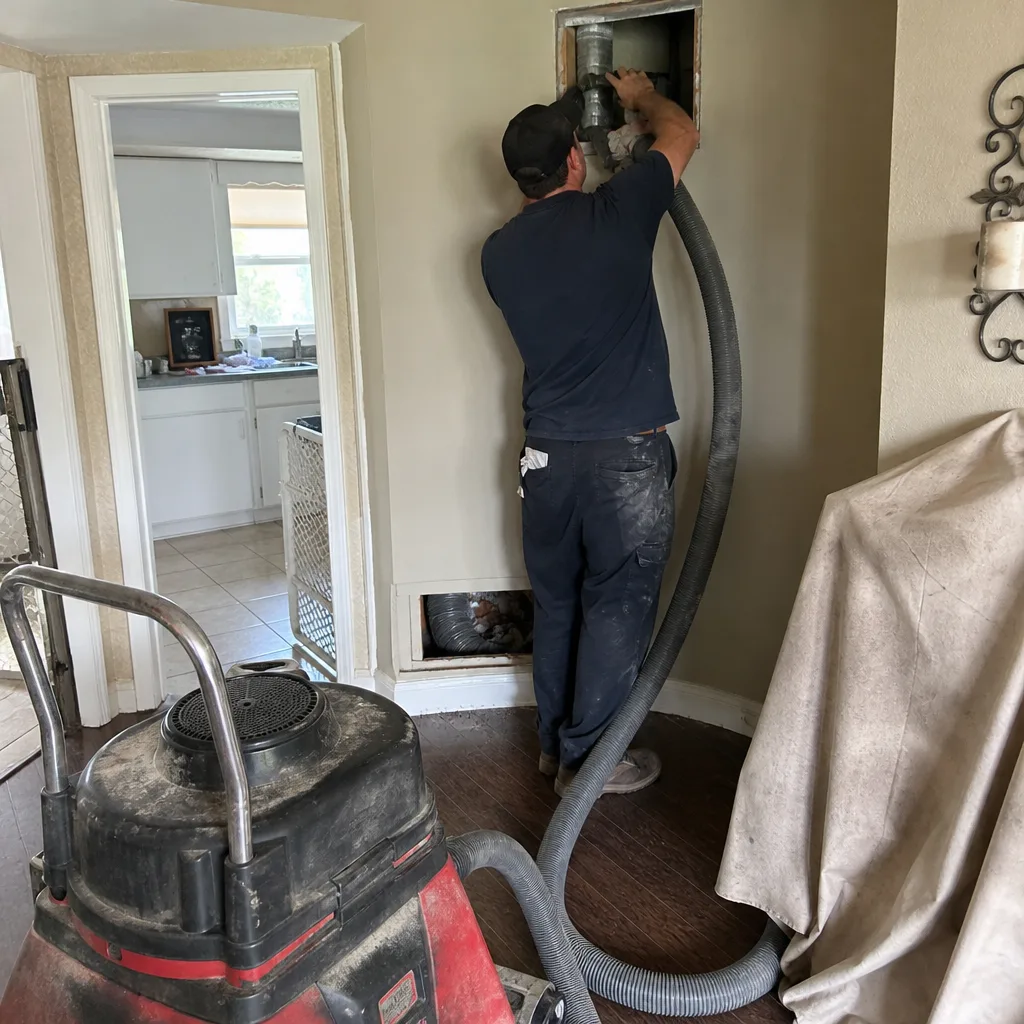 Before
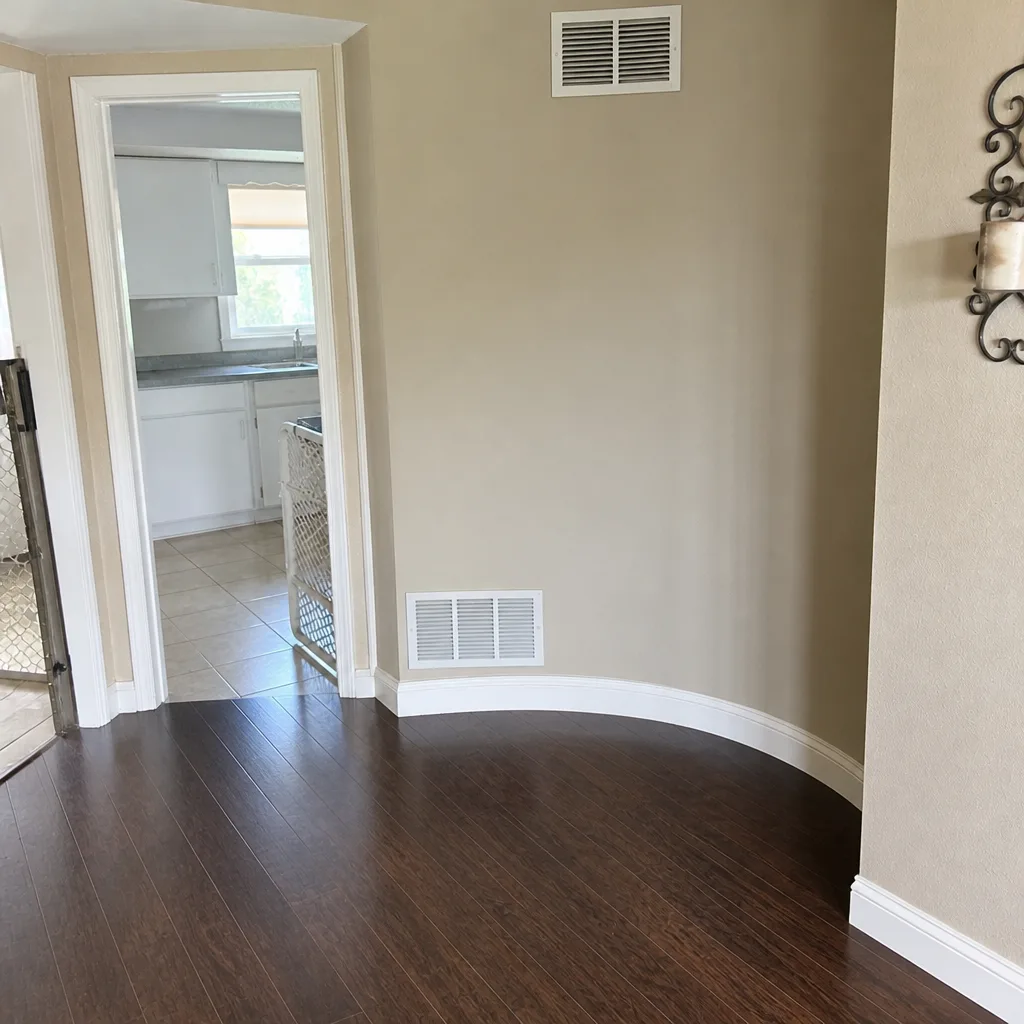 After
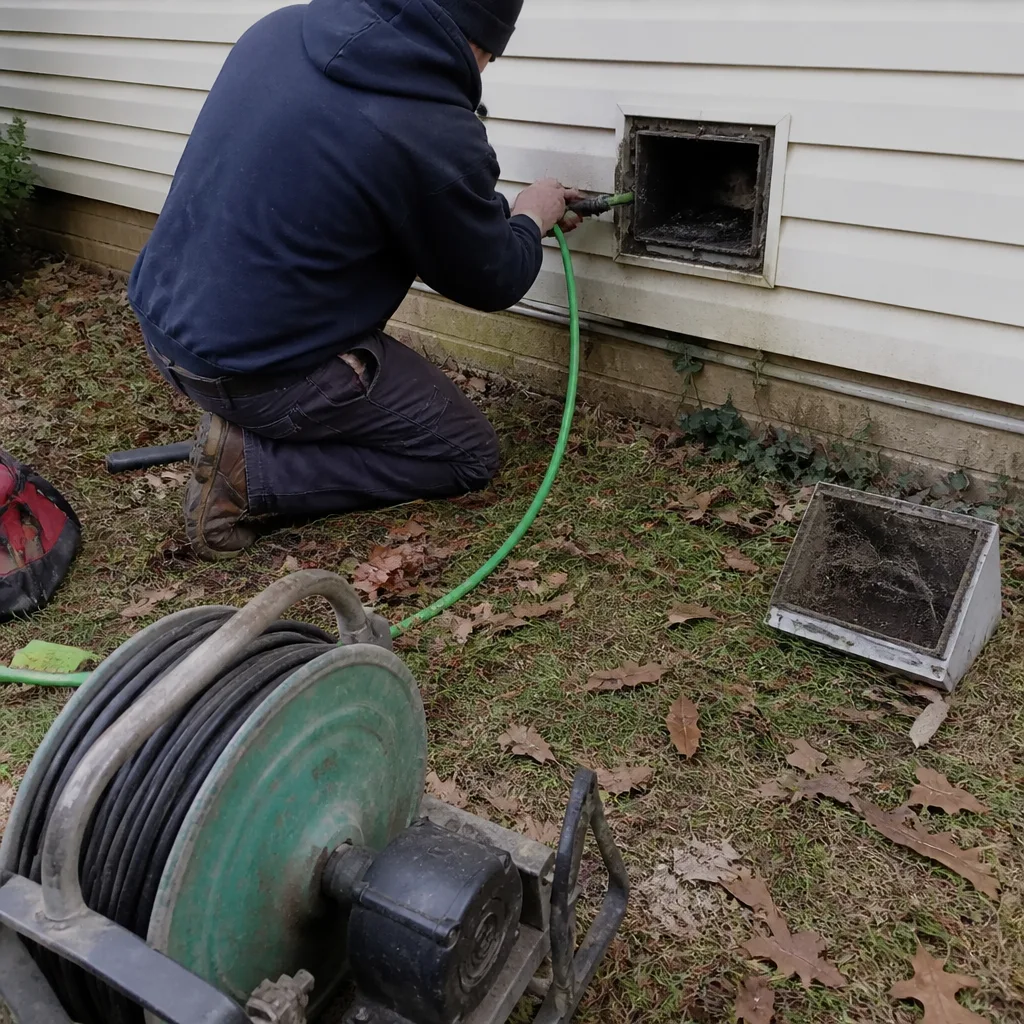 Before
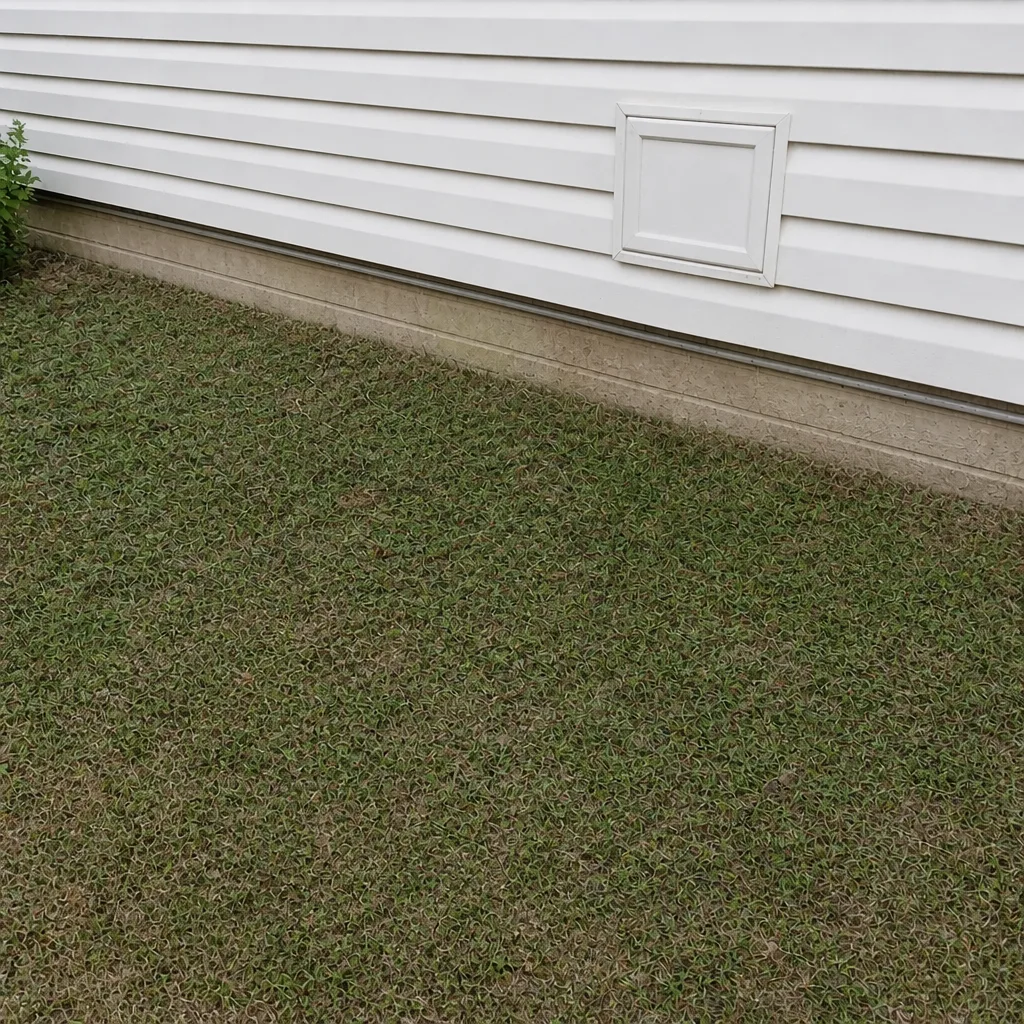 After
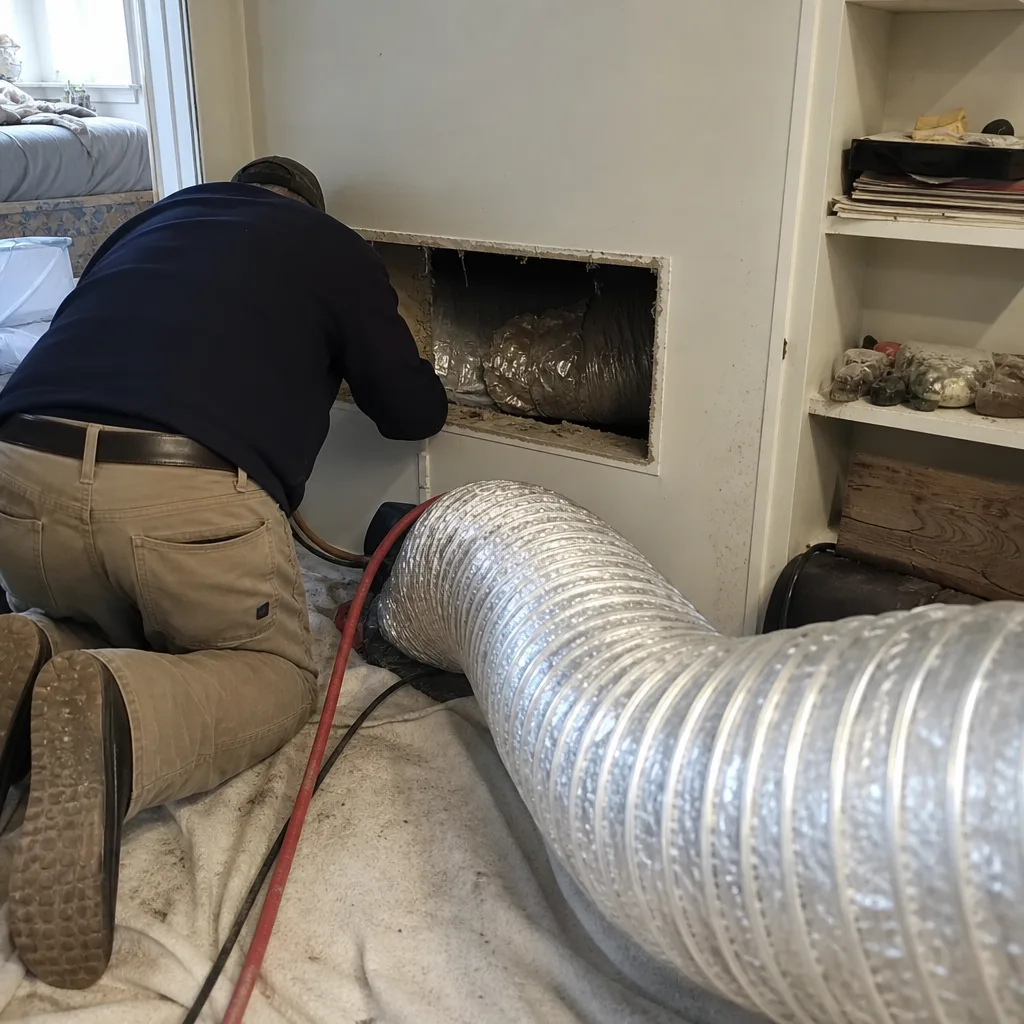 Before
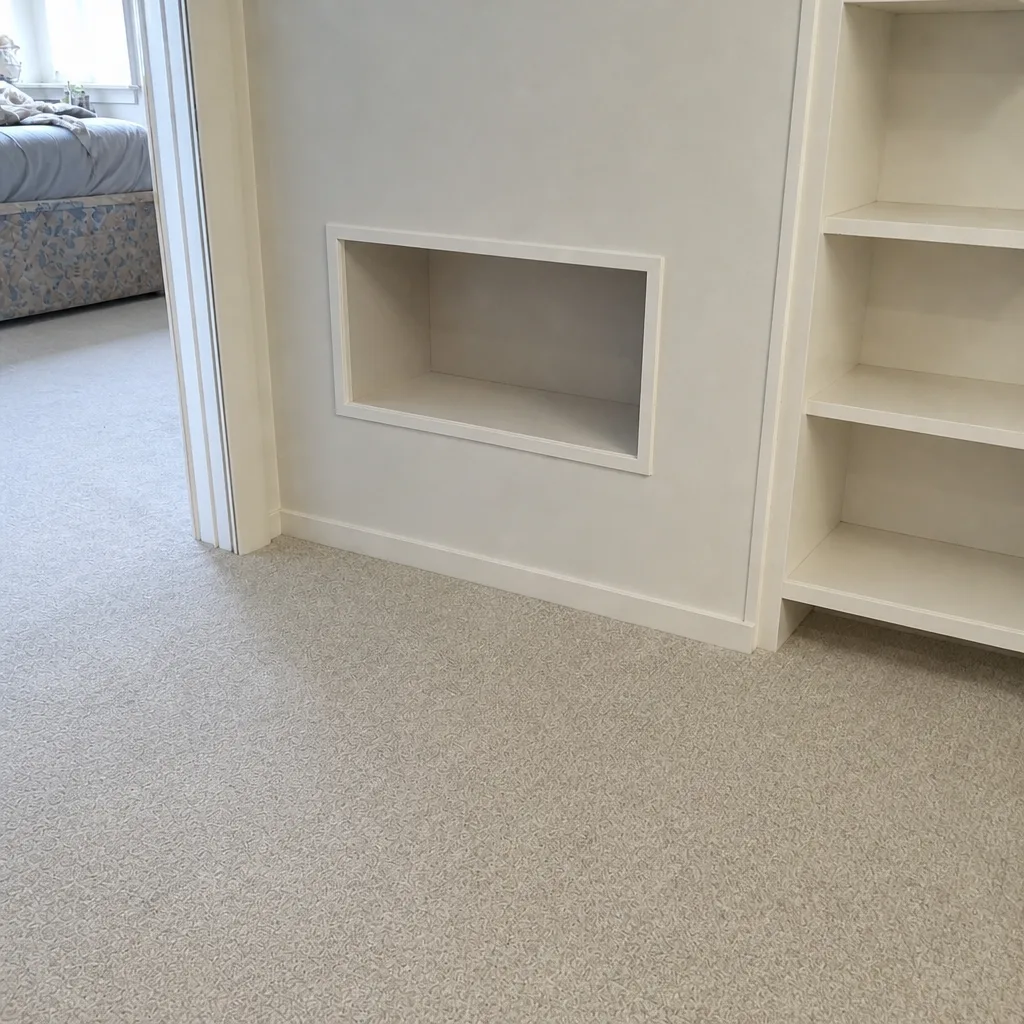 After
When to Call a Professional
Call a professional when the system hasn’t been cleaned in several years, when you’ve recently renovated, or when anyone in the home has respiratory sensitivities that get worse indoors. Call when the dryer takes much longer than it used to, or when the vent run is long or has multiple bends. Call when you own a home with older flex duct you’re not sure about, or when you see signs of moisture in the system. Call when your filtration system is a Honeywell or Aprilaire setup and you want the cleaning handled around it rather than through it. Duct Cleaning Suffolk offers free estimates in Suffolk – call (855) 740-0661. We answer 24/7. Fast dispatch from 7am to 7pm, Sunday through Friday.
Frequently Asked Questions
Partially. A shop-vac can clean register grilles and the first few feet of accessible duct, but it can’t generate negative pressure or agitate a full duct run, so it can’t clean a whole system. It’s useful for maintenance, not for full-system cleaning. Call (855) 740-0661 for an exact quote – the estimate is free.
Most homes need professional cleaning every three to five years, or sooner after renovation, water intrusion, pest problems, or in homes with heavy shedding pets. Homes with older flex duct or a known dust problem may benefit from a professional inspection sooner. Call (855) 740-0661 for an exact quote – the estimate is free.
Surface cleaning of a short, straight dryer vent run with a consumer kit is safe and useful. It becomes unsafe to assume the job is done when the run is long, has bends, or exits through the roof – lint in those areas is the fire risk. Professional cleaning addresses the full run. Call (855) 740-0661 for an exact quote – the estimate is free.
Cheap quotes typically reflect a smaller scope – often register cleaning only, no coil access, no negative-air containment, no repair follow-up. The bait-and-switch pattern is a low advertised number that grows once the technician at the door finds “unexpected” problems. Our pricing is one flat price per system, agreed before work starts, and the work is documented with before-and-after photos of your own ducts.
Documentation is the answer. Ask for before-and-after photos of your ducts taken at the same locations. Professional equipment like Rotobrush and Abatement Technologies units produce visible, documentable results; you should be able to review them. Call (855) 740-0661 for an exact quote – the estimate is free.
It can, especially in older homes with years of accumulated dust, or after a renovation. Cleaning removes the soil load that allergens cling to, and pairing it with proper filtration (a Honeywell or Aprilaire system, correctly sized and maintained) is the most effective combination. Call (855) 740-0661 for an exact quote – the estimate is free.
The Bottom Line
DIY duct cleaning isn’t a mistake so much as a tool with a narrow reach. It cleans registers, the first few feet of accessible duct, and the easy portion of a dryer vent – all valuable, all legitimate maintenance between professional cleanings. What it can’t do is evacuate a full duct system, agitate long flex runs, or clean the coil compartment without contamination. Those tasks need professional equipment and containment. In an older Suffolk home with brittle flex duct, DIY carries a specific risk of loosening compromised connections. The right approach combines both: DIY upkeep, professional cleaning when the system is due. For a clear, honest assessment of your own system, connect with the team at Duct Cleaning Suffolk or browse the Suffolk service pages. Call (855) 740-0661 for a free estimate.
Written by the team at Duct Cleaning Suffolk.